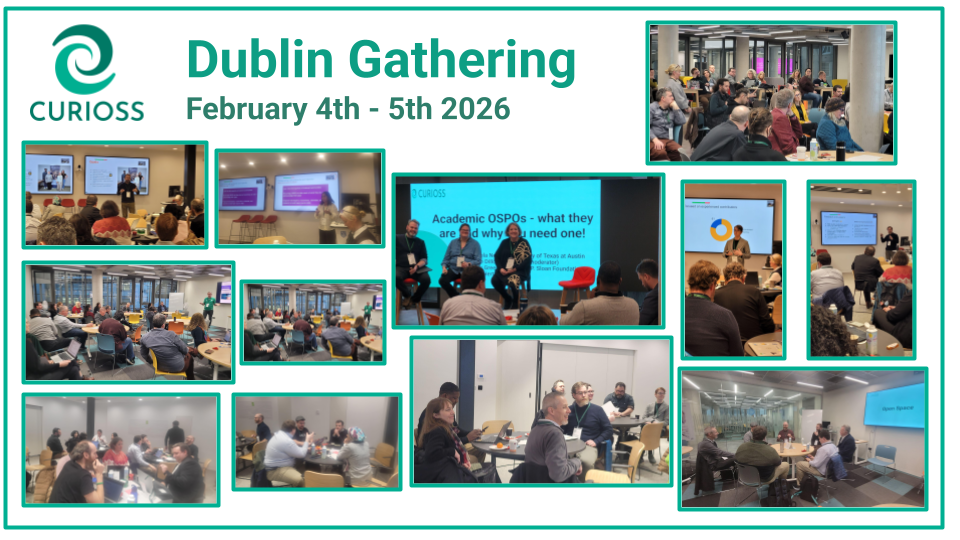
The 2026 CURIOSS Gathering took place in Dublin from February 5th-6th.
The two day event brought together CURIOSS members working in academic Open Source Program Offices (OSPOs), the academic open source community and the wider ecosystem to highlight the impact of open source in academia and to explore the role that OSPOs play as centers of competency for open source software within their institutions.
Day 1 was an exclusive members-only session, welcoming over 30 participants from 20 academic OSPOs to share learning, exchange best practice and engage in critical dialogue about their work.
Day 2 opened up the conversation to a broader audience spanning academia and the wider open source ecosystem. A series of talks, ‘Ask the Experts’ sessions and open discussions tackled pressing questions about open source in academia today.
Click the links below for recordings of each session.
Day 1 - Best Practice Talks
- Francesca Vera, OpenSource@Stanford: From Code Review to Community: Academic OSPO Partnership with pyOpenSci and rOpenSci
- David Lippert, GW Open Source Program Office: OSPO-tunity Knocks - Moving your management out of the shadows and into GitHub
- Matthew Feickert, University of Wisconsin-Madison OSPO: UW-Madison OSPO: Open Source Software Internship Program
Day 2 - Open Addresses
-
Clare Dillon, CURIOSS: Welcome and Opening Address
-
Josh Greenberg, Alfred P. Sloan Foundation: Why Open Source matters for Open Science
-
Sarah Novotny, Trinity College Dublin: How OSS intersects with AI
-
Panel: Academic OSPOs - what they are and why you need one!
- Angela Newell, UTAustin OSPO
- Clare Dillon, CURIOSS
- Josh Greenberg, Alfred P. Sloan Foundation
- Kate Hertweck, Biohub
Day 2 - General Sessions
-
Panel: CURIOSS OSPO Case Studies
- Bill Branan, Johns Hopkins University OSPO
- Collin Capano, Syracuse University OSPO
- Jacek Plucinski, SnT, l’Université du Luxembourg
- Marvin Barksdale, Mass General Brigham Innovation
-
Sayeed Choudhury, Carnegie Mellon University OSPO, Open Forum for AI: An Open Technology Stack for AI
-
Panel: Governance for Academic Open Source
- Ciarán O’Riordan, Eclipse Foundation
- Emily Lovell, UC Santa Cruz OSPO
- Kalle Westerling, Chainguard
- Richard Littauer, CURIOSS
-
Panel: What are the skills required for the future of software development?
- Clare Dillon, CURIOSS
- Daniel Ruggeri, Mastercard
- Stephen Walli, Microsoft
-
Dr. Daniel Izquierdo Cortázar, Bitergia: The Geopolitics of Code: From Digital Sovereignty to Global Fragmentation
Day 2 - Deep Dives
-
Ana Jiménez Santamaría, PyTorch Foundation: OSPO Academic Outreach Program
-
Dr. Colin Keogh, Inlecom Commercial Pathways, Sapien Innovation: From Funded Openness to Sustainable Impact - Operationalising Open Source in Academic Research
-
Ciarán O’Riordan, Eclipse Foundation: How European Regulations impact OSS for Open Research
-
John Durcan, IDA Ireland: Ireland as a Partner for Open Source Innovation
-
Vincent Sha, Carnegie Mellon University: Open Forum for AI: DARE - An Ecosystem for AI integration in Academic Settings
-
Panel: Enabling Research Software Engineering
- Aedín Culhane, University of Limerick
- Angela Newell, UTAustin OSPO
- David Pérez-Suárez, Advanced Research Computing Centre, University College London
- Richard Littauer, CURIOSS
-
Malcolm Bain, Across Legal: Open Source Licensing for Success
Day 2 - Ask the Experts
-
Panel: Steps to Setting up an Academic OSPO
- David Lippert, GW Open Source Programs Office
- Duane O’Brien, Capital One (moderator)
- Vessela Ensberg, University of California, Davis OSPO
- Zach Chandler, OpenSource@Stanford
-
Panel: How OSPOs can facilitate cross-sector collaboration
- Addie Cobb, Varro
- Ana Jiménez, Linux Foundation
- Stephanie Lieggie, UC Santa Cruz OSPO
- Austin Check, Office of Technology Management, Mississippi State University
Acknowledgements
Many thanks to the Alfred P. Sloan Foundation for their generous support, which made the CURIOSS Gathering possible.
We’re also very grateful to the Trinity College Dublin OSPO for partnering with CURIOSS to host the event.