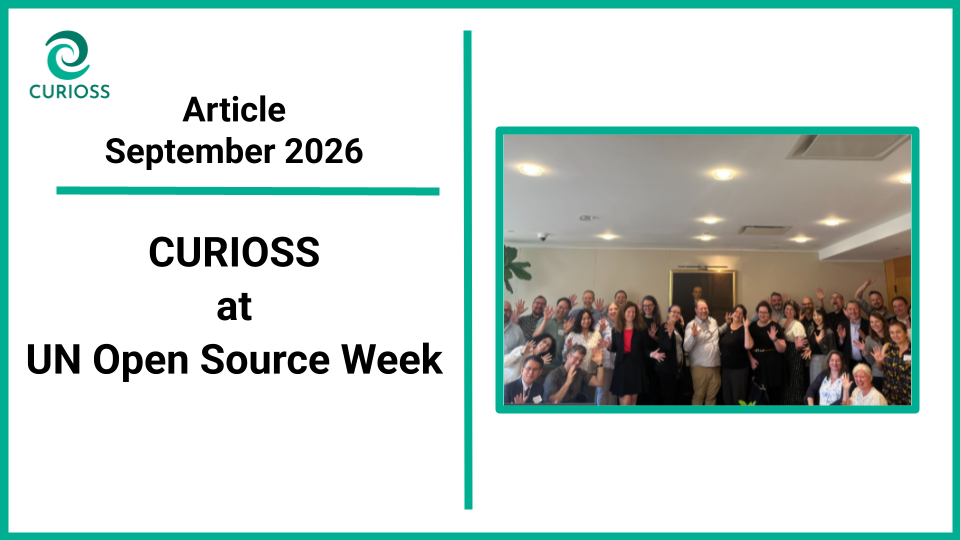
CURIOSS at UN Open Source Week 2026
Session overview
Session: Building Open Source Capacity at Scale: University OSPOs as Engines for SDG Impact
Event: UN Open Source Week 2026, OSPOs for Good
Date: Thursday 25 June 2026, 15:00 to 16:00
Venue: Training Room, Dag Hammarskjold Library, United Nations Headquarters, New York
Convened by: CURIOSS - the Community for University and Research Institution OSPOs
Speakers
Clare Dillon Community Lead, CURIOSS
Thomas Hughes OSPO Community Manager, Carnegie Mellon University Open Source Programs Office
Jennifer Schopf Networking Partnerships Directorate and LCCF Science Liaison, Texas Advanced Computing Center, UT Austin
Zach Chandler Executive Director, OpenSource@Stanford; Director of Open Scholarship Strategy, Institute for Human-Centered Artificial Intelligence (HAI)
Joined by panelists:
Mithusa Kajendran Open Source Adoption Consultant, UN-OICT and other CURIOSS contributors:
Daniel Shown Program Director for Open Source, Saint Louis University
Emily Lovell Associate Director of OSPO, UC Santa Cruz
Sayeed Choudhury Associate Dean for Digital Infrastructure and Director of the OSPO, Carnegie Mellon Libraries; Executive Director of the Open Forum for AI
Presentation slides
The lightning talk slides from the session are linked below:
Thomas (Tom) Hughes, Carnegie Mellon University UN SDGs and Campus Community Events
Jennifer Schopf, Texas Advanced Computing Center, UT Austin The Texas-OSPO and UN SDGs
Zach Chandler, OpenSource@Stanford University as Open Source Accelerator
Article
Introduction
The CURIOSS community was delighted to return to UN Open Source Week 2026 in New York this June.
Building on our participation last year, we hosted a session dedicated to a question that sits close to the heart of academic open source: how can university and research institution Open Source Program Offices (OSPOs) help deliver the Sustainable Development Goals?
Over the past few years, the number of OSPOs and OSPO-like activities in universities and research institutions has grown significantly and many of them are already designed to support the SDGs. Our session, “Building Open Source Capacity at Scale: University OSPOs as Engines for SDG Impact”, set out to explore what has been done, share what is in progress, and think together about how academic open source can do more to drive real impact. It formed part of the conference’s “OSPOs for Good” day, and brought together CURIOSS members and open source advocates from institutions around the world.
Lightning talks: SDG impact in practice
We opened with a series of short lightning talks from three CURIOSS speakers, each grounding the discussion in real initiatives.
Tom Hughes of the Carnegie Mellon University OSPO, Jennifer Schopf of the Texas Advanced Computing Center at UT Austin, and Zach Chandler of OpenSource@Stanford shared how academic open source is already being put to work on global challenges. Their slides are linked above.
Between them, the talks showed what SDG-focused academic open source looks like on the ground. The UN Reboot the Earth hackathon series has brought university OSPOs into direct collaboration with students and communities working on climate and food security, from the CMU OSPO supporting students at CMU Africa in Kigali building open source tools to connect rural farmers in Rwanda to markets, to the UC OSPO Network at UC Santa Cruz bringing students together with CAL FIRE and emergency responders to build AI tools for wildfire detection and response.
If you want to learn more about Reboot the Earth, contact Mithusa (mithusa.kajendran@un.org) at the UN Office of Information and Communications Technology.
Jennifer Schopf Texas-OSPO shared how the Texas Advanced Computing Center gives researchers worldwide access to high performance computing through its NSF Leadership Class Facility and programs such as Advanced Computing for Social Good, connecting research infrastructure directly to public benefit.
Zach Chandler offered a close look at how a university can act as an open source accelerator, describing how OpenSource@Stanford has taken the Natural Capital Alliance’s InVEST toolset, which now underpins UN-adopted ecosystem accounting and maps to a wide span of the SDGs, and deliberately built a durable community around it through a modular, plugin-friendly architecture, contributor roundtables, a plugin registry, and an annual symposium. His central message resonated across the room: building the software is only the start, and it takes intentional community work to turn a strong research project into a thriving open source ecosystem.
Who was in the room
Before the workshop, a quick poll asked who had joined us, and the room turned out to be split almost evenly between academic and non-academic participants. The split points to real appetite both for peer exchange among established OSPOs and for the on-ramps that help new institutions get started, alongside strong interest from the wider open source community.
What the community told us
The talks were followed by a short interactive workshop, where we invited everyone in the room to answer a single question: how do you think academic OSPOs can impact the Sustainable Development Goals? Participants shared their thoughts and reading them together, a clear agenda emerged. We brought back this input to the CURIOSS community and have elaborated on some of the core themes below:
- Build open source literacy and real skills: Our community sees academic OSPOs as a natural home for open source literacy, from the fundamentals of Git through to cloud native tools, delivered through workshops, hackathons, bootcamps, and lunch and learn sessions. Several people stressed that this literacy should reach beyond computer science students and beyond code alone, closing the gap for non-developers and treating documentation, maintenance, and collaboration as first-class skills. A recurring theme was that students learn best on real open platforms rather than throwaway exercises, gaining genuine experience building and shipping software that matters.
- Connect students to real-world projects: Rather than focusing only on incubating new projects inside the university, participants asked how students might be encouraged to contribute to existing open source communities, and in particular to projects already advancing the SDGs. Ideas included choosing a goal that directly affects students and then involving them in active building and contribution, having graduate students mentor undergraduates, and running codeathons across departments so that the work draws in more than just the computer scientists, with SDG outcomes as the explicit goal.
- Sustain and maintain what we build: Sustainability ran through many of the responses, as both a value and a gentle warning. Participants pointed to the need for stability, for project leads to onboard their successors before they move on, and for OSPOs to keep projects healthy enough that students can contribute effectively. As one participant put it from a cybersecurity perspective, academic OSPOs turn student projects into lasting public goods and train new open source talent, but that impact only holds if the tools stay secure and maintained over time.
- Share resources and reduce duplication: There was an appetite for shared resources that reduce duplicated effort. Suggestions included an “OSPO in a box” shared training resource, better visibility of existing work and data so that resources are not recreated from scratch (a concern sharpened by AI), and reusable challenge repositories that students can pick up for projects, including one idea aimed at lowering the cost of digital transition for low income countries. Clear, non-technical documentation was seen as essential to making any of this genuinely reusable.
- Collaborate and consolidate across the ecosystem: Our community framed impact as a shared effort, calling for close collaboration with industry, with community, with non-profit foundations that can host projects and build sustainable communities around them, and with stakeholders who bring real-world problems in need of SDG-aligned solutions. Several noted that SDG efforts too often run in silos, and saw a role for CURIOSS in helping to connect and consolidate them.
- Scale up and shape policy: Others looked further outward, hoping to see academic OSPOs scale beyond single campuses and countries, support the implementation of academic findings in public policy, and act as experimentation-driven action labs with immediate impact on their communities. Underneath it all sat one simple structural point, made more than once: to do any of this well, an institution first needs an OSPO.
- And have fun: Amid all the strategy, one contributor offered a two-word reminder that drew agreement in the room: have fun. It is a fitting note for a community whose strength comes from bringing people together around shared, open work.
Looking ahead
We came away from the session encouraged by the energy in the room and by how much of this work is already underway. The priorities our community surfaced, building open source literacy, connecting students to real projects, sustaining what we build, sharing resources, and collaborating across institutions, map closely to the work CURIOSS exists to support. We are grateful to everyone who joined, contributed, and shared their ideas so generously, to our speakers, and to the organizers of UN Open Source Week for the opportunity to explore academic open source as a pathway to the global common good. We look forward to carrying these conversations forward with our members in the months ahead.
A note on AI use: This content was drafted with the help of AI. As a small organization, AI tools help us turn rich conversations into written resources with less effort - meaning we can offer more to the community. As always, there are plenty of human eyes reviewing, editing, and improving the content before it is published. Thanks go to our community for the insights. If you do spot any errors, please let us know so we can correct them!
Appendix: full Mentimeter input
Source: Academic OSPOs and the SDGs, Interactive Conference Session (Mentimeter), CURIOSS session at UN Open Source Week 2026, Thursday 25 June 2026.
Question 1: How do you think academic OSPOs can impact the Sustainable Development Goals?
Responses received: 28 of 59 participants. All contributions are reproduced below.
- Sustainability and stability.
- Students are very motivated to address climate change. So more pathways and onramps for students to leverage OSS to address climate change.
- Talk about it to raise awareness.
- Open Source Literacy (using git, cloud native tools, workshops / hackathons / bootcamps / lunch and learn sessions, doing more than code for maintenance).
- Improve the learning, based on real open platforms instead of joke projects.
- Project leads onboard new project leads when preparing to leave.
- Visibility, maybe data cleaning, not having to recreate existing work / resources, especially for AI. How about an “OSPO in a box” shared training resource?
- Sustainable development is related to many social challenges to be tackled by researchers. So academic OSPOs should support such research.
- Get graduate students mentoring undergraduates.
- It seems that much of the focus is on incubating open source projects that originate within the university. What are your thoughts on encouraging students to contribute to existing open source communities?
- By supporting open source software networks with youth, it can ensure the access to quality education to all students involved.
- Scale to OSPOs in other countries.
- Support implementation of academic findings in public policies.
- Collaborate with industry and community.
- Clear and non technical documentation.
- By making sure academic OSPOs have sustainability with OS projects so that students can contribute effectively. Also, academic institutions must have an OSPO.
- Building a set of GDG challenges repo the students can use for projects, so that they can reduce the cost of digital transition for low income countries.
- It will support university students to have experience developing real software and gain real experience.
- Have fun!!
- Education and closing the literacy gap between different groups (non-dev included).
- By first selecting a goal that directly impacts the students. Then involving the students in active building and contribution.
- Become experimentation-driven action labs with the intent to have immediate impact on localities, communities and democratic participation and trust-building.
- More collaboration with non profit foundations that can host the open source projects and work on discoverability and building sustainable communities around them.
- Connect students with open source projects working on SDGs.
- Enable people to be involved in co-creation of knowledge and solutions.
- Close collaboration with stakeholders and organizations who have real world problems and need solutions that align with SDGs.
- Academic OSPOs turn student projects into lasting public goods and train new open-source talent. From my cybersecurity side, that impact only holds if the tools stay secure and maintained. +1
- GIT training: merge, pull, push. Get different areas involved.
- Label it.
- SDG goals is working in silos. It would be great for CURIOSS to work with them and consolidate.
- Codeathons across departments to find more than just the computer scientists, and have SDG as the end goals.
Question 2: Who is in the room?
Responses received: 45 of 59 participants.
- I work in or with an academic OSPO: 15
- I work with an academic institution that does not have an OSPO: 9
- I do not work in an academic institution but am interested in the topic: 21